

Inside Claude Code: The Architecture That Makes AI Actually Do the Work
A layer-by-layer breakdown of the agent loop, permission system, compaction pipeline, and subagent orchestration powering autonomous AI development

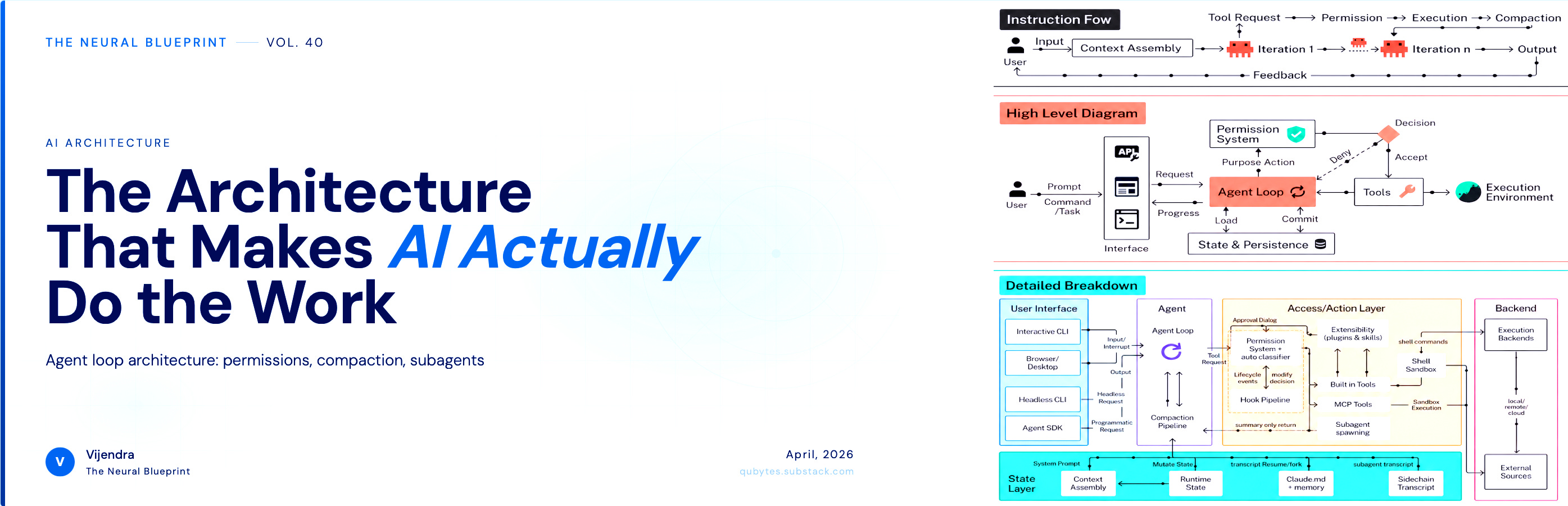
Claude Code architecture is more sophisticated than almost anyone is discussing. You’ve probably heard it called an autonomous developer but most commentary stops at the surface: it writes code for you! That’s like saying a jet engine makes planes go fast. True. Also, wildly underselling the engineering.
Today, I’m pulling apart the full Claude Code architecture layer by layer so you understand not just what it does, but why it’s built the way it is, and what it means for how we build agentic systems going forward.
The 30-Second Mental Model
Before we go deep, here’s the intuition:
Claude Code is a while-loop surrounded by serious infrastructure.
The core agent loop assemble context, call the model, receive a tool request, execute it, repeat is conceptually simple. The real engineering genius lives in everything around that loop: the permission system, the compaction pipeline, the hook architecture, and the subagent spawning mechanism. This is a pattern every agentic system builder needs to internalize.
Layer 1: Instruction Flow → The Iterative Engine
The top-level flow is elegantly simple:

Each iteration is a turn. Within a turn, Claude may request a tool call. That request flows through permission checking, then execution, then feeds back into the loop—with feedback continuously bubbling back to the user as progress. This isn’t a one-shot request/response model. It’s a sustained reasoning loop where each tool execution enriches the context for the next step.
What this means for builders: If you’re designing agentic workflows, your mental model should shift from prompt → answer to prompt → iterative execution graph. The number of iterations is non-deterministic and driven by task complexity, not hardcoded logic.
Layer 2: The High-Level Architecture → Five Core Subsystems
Zooming in reveals five critical subsystems that every serious agentic system needs:
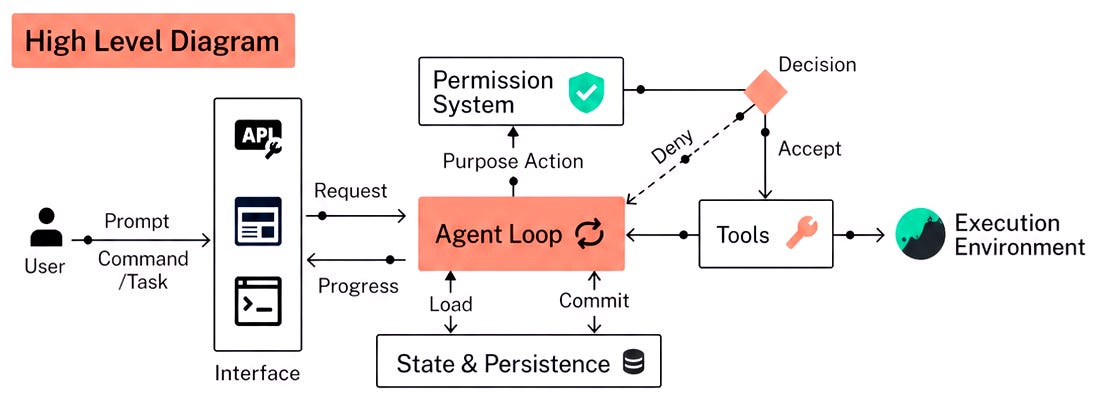
The Agent Loop → The heart of the system. It orchestrates everything: assembles the context window, dispatches requests to the model, routes tool-use responses back to the appropriate executor, and commits state at the end of each turn. It’s a feedback controller, not a pipeline.
The Permission System → This is where Claude Code does something most agentic frameworks skip: it makes safety a first-class architectural concern. The permission system sits between the agent loop and tool execution. Every tool request goes through an approval gate. The system uses an ML-based auto-classifier with seven distinct permission modes to determine what requires human confirmation vs. what can be auto-approved. The diamond-shaped Decision node in the diagram isn’t decorative—it represents a hard fork: deny sends feedback back to the agent loop; accept lets execution proceed. This is how you build autonomous systems that remain trustworthy.
Tools & Execution Environment → Tools are the actuators—the hands of the agent. Claude Code ships with built-in tools (file read/write, bash execution, grep, glob) and extends via MCP (Model Context Protocol) for external service integrations. Crucially, all tool execution runs through a Shell Sandbox, isolating side effects and limiting blast radius. Remote execution backends (local/cloud/remote) let the system scale beyond the developer’s machine.
State & Persistence → State is managed as an append-oriented session transcript. This isn’t just logging—it’s the substrate for resume, fork, and rewind operations. Claude.md files and memory inject persistent project context across sessions. Sidechain transcripts capture subagent interactions separately, preventing context pollution of the main thread.
The Compaction Pipeline → This is the most underappreciated component. As conversations grow, context windows fill. Rather than naively truncating, Claude Code employs a five-layer compaction pipeline: it spawns a forked subagent whose sole job is to produce a structured summary of the conversation, then re-injects only what matters—the last 5 file attachments, active skills, plan state, and tool deltas.
The compaction prompt is ~6,500 tokens, tuned specifically for software engineering tasks: file paths, code snippets, error histories. This is structured extraction followed by selective reconstruction not summarization. The architecture treats context as a managed resource, not an infinite buffer.
Layer 3: The Detailed Breakdown → Where the Magic Lives
The bottom layer of the diagram reveals the full component map across four vertical zones:
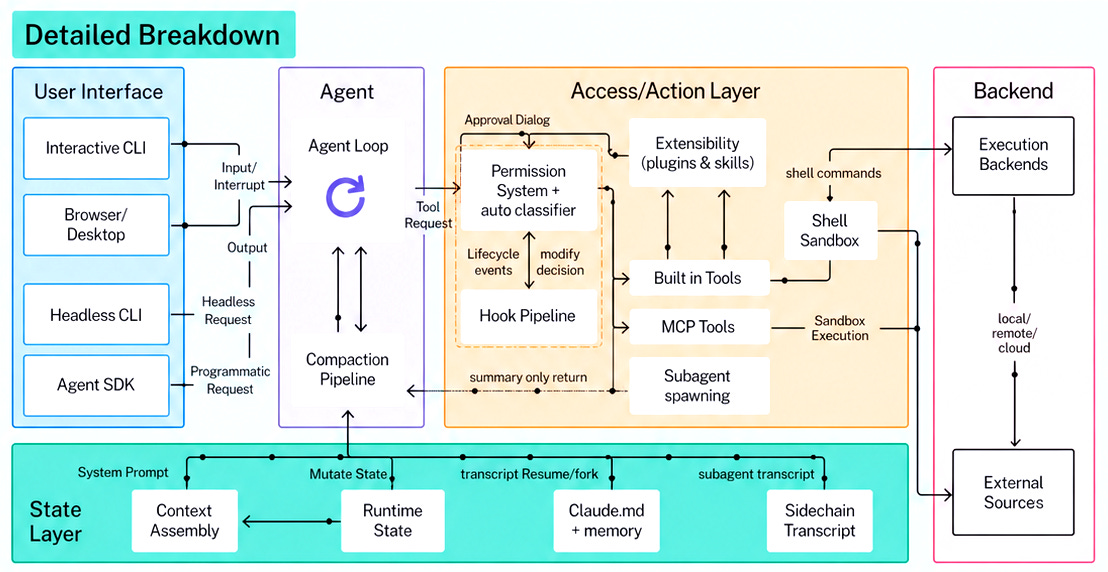
User Interface Layer → Four entry points: Interactive CLI (the developer experience), Browser/Desktop (GUI surface), Headless CLI (CI/CD pipelines), and Agent SDK (programmatic embedding). This multi-modal interface strategy is intentional—it means Claude Code can operate as a human-facing tool or as a component inside a larger automated system. The same agent loop powers all four surfaces.
Agent Layer → The Agent Loop + Compaction Pipeline live here. The loop handles input/interrupt signals from the UI layer and emits output back. The compaction pipeline runs asynchronously, triggered by context thresholds invisible to the user, essential to reliability.
Access/Action Layer (The Most Complex Zone) → This is where extensibility meets safety. Four mechanisms compose here:
Permission System + Auto Classifier: ML-powered intent classification before any action fires
Hook Pipeline: lifecycle event hooks (
PreToolUse,UserPromptSubmit,PermissionRequest) that let you intercept, modify, or block tool calls programmatically. This is where enterprise policy enforcement livesBuilt-in Tools + MCP Tools: native capabilities plus the extensible protocol layer for third-party integrations
Subagent Spawning: the orchestrator-worker pattern in action. The main agent can spawn specialized subagents, pass them restricted tool sets, and receive only a summary return. Parallel subagent execution enables tasks that would be too large for a single context window
State Layer → Context Assembly builds the system prompt from Claude.md, memories, and runtime state. Runtime State mutates per turn. Claude.md + memory provides the persistent knowledge layer. Sidechain Transcripts capture subagent interactions, keeping the main thread clean.
The Architecture Patterns Worth Stealing
If you’re building agentic systems for enterprise, for internal tooling, for SaaS, here are the transferable insights:
Safety as a subsystem, not an afterthought: The permission system is architecturally separate from tool execution. Design yours the same way
Context is a managed resource: Build compaction into your system from day one, not as a patch when things break
Hooks are your enterprise integration surface: Lifecycle hooks let you plug in policy, logging, compliance, and custom routing without touching core agent logic
Subagents enable horizontal scaling of reasoning: Don’t try to solve everything in one context window. Delegate, summarize, and return
Multi-surface interface from the start: The same agent logic should power CLI, GUI, headless, and SDK surfaces design for all four even if you ship one
Subscribe to The Neural Blueprint
By Vijendra
Deconstructing the architecture of modern AI systemsWhy This Matters Right Now
Claude Code’s architecture was effectively reverse-engineered from an unintentional source code leak in March 2026 and what the community found was a system far more sophisticated than anyone expected. This isn’t a chatbot with file access bolted on. It’s a production-grade autonomous execution system with carefully considered tradeoffs at every layer.
When you working with enterprise teams evaluating agentic AI adoption, this architecture is the benchmark. You should provide your answer before your customer ask: How does your permission system work? What’s your compaction strategy? Can I hook into the lifecycle? How does subagent delegation handle context isolation?
If you can’t answer those questions, you’re not looking at a production-ready agentic system. You’re looking at a demo.
What’s Next
In the next issue of The Neural Blueprint, I’ll be breaking down the Hook Pipeline in depth how to use PreToolUse and PermissionRequest hooks to build enterprise-grade governance layers on top of Claude Code, including policy enforcement, audit logging, and custom approval workflows.
If you’re building agentic systems in an enterprise context, you won’t want to miss it.
See you till next…
Vijendra | The Neural Blueprint
Building the architecture of the agentic era, one system at a time